HARIKRUSHNA MARKETING — Suppliers
About HARIKRUSHNA MARKETING - Tractors and Farm Machinery Supplier in India
HARIKRUSHNA MARKETING is an exporter and dealer based in Amreli District, Gujarat, India, listing 37 active products focused on tractors and farm machinery. The catalogue is dominated by utility and mid-range tractors from five OEMs, with horsepower classes spanning compact models around 21 HP up to heavy-duty units above 75 HP, including 2WD and 4WD configurations. Construction and heavy equipment lines also appear alongside the agricultural range, reflecting a mixed inventory of agricultural tractors and earthmoving/machinery units. The supplier operates from one of India's principal agricultural belts in Gujarat, a state with a long-standing role in farm mechanisation and tractor distribution.
The product mix covers orchard and inter-culture tractors in the 21-36 HP segment, general-purpose 45-55 HP tractors, and heavier 60-80 HP row-crop and haulage models. Buyers browsing the catalogue will find multiple brand families represented, with several models offered in both 2WD and 4WD variants. The range is structured around diesel-powered agricultural prime movers suited to tillage, haulage, rotavation, and PTO-driven implements, with selected construction equipment units rounding out the offering.
Product Range and Specialties of HARIKRUSHNA MARKETING
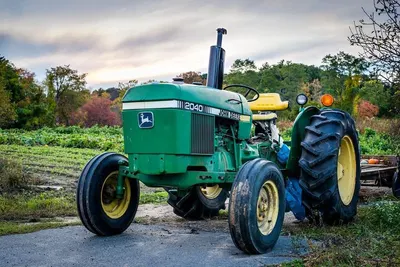
The 37-item catalogue breaks down into roughly 30 tractor models across Kubota, John Deere, DEUTZ-FAHR, VST Shakti, and Mahindra, plus a small set of heavy and construction equipment lines. Kubota listings include the A211N (around 21 HP), Neostar B2441, L4508, MU4501, 5501 4WD, M7040, and M9540, covering orchard, compact utility, and mid-to-large row-crop segments. John Deere models include the 3036 EN, 5045 PowerPro, 5050 (2WD and 4WD), 5065, 5075 TREM-III, 5105 4WD, and 5405, spanning 36 HP to 75 HP. VST Shakti entries cover the MT 270, 130 DI, 130 DI Ultra, 927, and 932, typically in the 27-33 HP compact range. DEUTZ-FAHR listings include the Agrolux 50, Agrolux 70 (2WD and 4WD), and AGROPLUS F Keyline 55, 65, and 80.4. Mahindra models include the Jivo 245, Arjun Novo 605 Di-i 4WD, Novo 655 DI, NOVO 755 DI, and Arjun 8085, reaching into the 80+ HP heavy-duty class.
Tractors in this category are typically classified by horsepower band, drive configuration (2WD versus 4WD), transmission type (sliding mesh, constant mesh, partial synchromesh, full synromesh, or powershift), PTO HP, hydraulic lift capacity in kg, and emission standard compliance such as India TREM-III (Tractor Emission Regulation-III) or equivalent EU Stage V / US EPA Tier 4 Final for export markets. Buyers in this segment commonly compare specifications including engine displacement in CC, number of cylinders (typically 3 or 4), fuel tank capacity, turning radius with and without brakes, ground clearance in mm, and total weight in kg. Implements and matching equipment such as rotavators, cultivators, ploughs, and trailers are usually sourced separately, and the heavy equipment line items in the catalogue typically reference machinery categories covered under HS code 8429 (self-propelled bulldozers, angle dozers, graders, scrapers, shovel loaders, and the like) and HS code 8701 (tractors).
Trade and Export Information - HARIKRUSHNA MARKETING
Indian tractor exports typically flow to markets in Africa (Nigeria, Kenya, Tanzania, Ethiopia, Sudan, Ghana, Mozambique, Zambia), South and Southeast Asia (Nepal, Sri Lanka, Bangladesh, Myanmar, Philippines), and parts of Latin America, where demand centres on rugged, dry-land and smallholder farming equipment in the 20-75 HP range. Tractors fall under HS code 8701 (tractors other than those of heading 8709), with sub-divisions based on engine power, drive type, and use; agricultural machinery more broadly sits in HS chapter 84 (machinery and mechanical appliances) and parts under HS 8708. Buyers in these destination markets commonly require documentation including a commercial invoice, packing list, bill of lading, certificate of origin (often under an FTA such as the India-ASEAN or India-SACU framework where applicable), and an invoice-cum-value declaration for customs valuation. Pre-shipment inspection by agencies such as SGS, Bureau Veritas, Intertek, or TUV is typical for first-time orders, and many African and Asian buyers request a pre-dispatch inspection certificate before release of payment.
For Indian-built tractors, emission compliance is a frequent point of negotiation: units destined for Europe, North America, and increasingly the Gulf require EU Stage V or US EPA Tier 4 Final certification, while TREM-III compliance covers the Indian domestic market. Common certifications that buyers request or that exporters should hold include ISO 9001:2015 for quality management, and OEM-specific authorisations where the supplier acts as a dealer or distributor. Packaging is generally loose (machines on flat-rack or in containers with dismountable parts such as tyres, roll-over protection structures, and front weights removed and crated separately), with 20 ft and 40 ft flat-rack containers being the standard mode for 2WD units and 40 ft flat-rack for larger 4WD models. Incoterms typically used in this trade include FOB Indian port (Mundra, Kandla, Mumbai, or Chennai), CIF, and occasionally CFR, with sea freight being the dominant mode given the size and weight of units.
Sourcing from HARIKRUSHNA MARKETING - Buyer Guidance
Buyers sourcing from HARIKRUSHNA MARKETING should request the model-specific specification sheet for each tractor, including engine HP, PTO HP, engine displacement in CC, number of cylinders, transmission type, hydraulic lift capacity in kg, tyre size, and emission standard compliance. Where the catalogue does not list emission certification, buyers exporting to regulated markets should explicitly confirm whether the unit is TREM-III, EU Stage V, or EPA Tier 4 Final compliant, and request the relevant certificate or test report. For construction and heavy equipment lines, buyers should ask for operating weight, engine power in kW or HP, bucket capacity in m3, and hours of operation if the unit is used or refurbished. Documents typically required include the OEM invoice (to evidence brand authorisation), warranty terms, service manual, parts list, and pre-shipment inspection report from an independent agency. Payment terms in this segment commonly involve a 30% advance by T/T with balance against copy of B/L, or 100% irrevocable L/C at sight for first transactions; an L/C is advisable for new buyers given the unit value. Buyers should also confirm whether the price quoted includes ROPS, front weights, tyres, and implements, and clarify the Incoterm and port of loading before placing the order.
Frequently Asked Questions About HARIKRUSHNA MARKETING
What categories of equipment does HARIKRUSHNA MARKETING supply?
The supplier lists 37 active products, the vast majority being agricultural tractors in the 21 HP to 80+ HP range from Kubota, John Deere, DEUTZ-FAHR, VST Shakti, and Mahindra, plus selected heavy and construction equipment units. Tractors fall under HS code 8701 and heavy equipment under HS code 8429.
Which tractor brands and horsepower classes are available?
The catalogue spans Kubota (A211N, Neostar B2441, L4508, MU4501, 5501 4WD, M7040, M9540), John Deere (3036 EN, 5045 PowerPro, 5050, 5065, 5075 TREM-III, 5105 4WD, 5405), VST Shakti (MT 270, 130 DI, 130 DI Ultra, 927, 932), DEUTZ-FAHR (Agrolux 50, Agrolux 70, AGROPLUS F Keyline 55/65/80.4), and Mahindra (Jivo 245, Arjun Novo 605 Di-i, Novo 655 DI, NOVO 755 DI, Arjun 8085). Horsepower ranges from about 21 HP in compact orchard models up to 80+ HP in heavy-duty row-crop and haulage units.
Which certifications and documents should the buyer request?
Buyers should request the OEM authorisation letter, engine emission compliance certificate (TREM-III, EU Stage V, or EPA Tier 4 Final depending on destination), ISO 9001:2015 quality management certificate if available, warranty card, operator and service manuals, and a pre-shipment inspection report from SGS, Bureau Veritas, or an equivalent agency. A certificate of origin and commercial invoice are required for customs clearance in the destination country.
What quality and specification checks are typical for tractors in this category?
Standard checks include verification of engine number and chassis number, cold-start test, hydraulic lift test at rated kg capacity, PTO operation, brake test, 4WD engagement test where applicable, and tyre condition and date code. Buyers should also confirm matching of the specification sheet with the actual unit, including engine displacement in CC, rated RPM, fuel tank capacity, and total weight in kg.
What is the typical MOQ and lead time for tractor exports from India?
For tractor shipments, MOQ is usually one unit, though container-load orders of 3 to 8 units in a 40 ft flat-rack are common for dealer buyers. Lead time depends on stock availability and ranges from immediate dispatch for in-stock units to 30-60 days for specific configurations, plus ocean transit of 15-35 days depending on the destination port.
How are tractors typically packaged and shipped?
Tractors are normally shipped loose on flat-rack containers with detachable parts such as roll-over protection structures, front weights, and sometimes tyres removed and packed in separate wooden crates to reduce dimensions. A 40 ft flat-rack typically accommodates 1 to 3 units depending on size, and 20 ft flat-racks are used for compact models. Sea freight from ports such as Kandla, Mundra, or Mumbai is the standard mode.
Which regions typically import Indian tractors and farm machinery?
Indian-built tractors are commonly exported to African markets including Nigeria, Kenya, Tanzania, Ethiopia, and Ghana, South Asian markets such as Nepal, Sri Lanka, and Bangladesh, and Southeast Asian destinations including Myanmar and the Philippines. Demand in these regions centres on rugged 2WD and 4WD models in the 35-75 HP range suited to dry-land farming, haulage, and PTO-driven implement work.




 Amreli District, India