Ajanta Stone Industries — Supplier
About Ajanta Stone Industries - Natural Stone Supplier in India
Ajanta Stone Industries is an India-based natural stone supplier operating from the country, with 5 active products listed across four stone categories: Sandstones & Sands, Marble & Granite, Granite Slabs, and Slates. The catalogue covers a deliberately Indian-stone-focused mix, including Modak sandstone, marble, Kashmir granite, slate stone, and Kota blue limestone circle, which together represent the principal natural stone families that Indian quarriers and processors export globally. The product mix reflects the geological diversity of Indian quarrying regions, where sandstone, granite, marble, slate, and limestone are extracted from distinct belts and processed into tiles, slabs, blocks, and shaped items. As a single supplier covering four stone families, the listing sits at the intersection of dimension stone and decorative stone trade rather than a single-commodity line.
The Indian natural stone sector is anchored by Rajasthan for sandstone, slate, and Kota limestone, by South Indian states for granite, and by Rajasthan and Gujarat for marble processing, which is the typical geographic context for the categories Ajanta Stone Industries lists. Sandstones, granites, marbles, slates, and limestones are classified under HS code 2515 (marble, travertine, ecaussine and other calcareous monumental or building stone), HS code 2516 (granite, porphyry, basalt, sandstone and other monumental or building stone), and HS code 6802 (worked monumental or building stone and articles thereof), depending on whether the material is quarried rough, roughly split, or further worked into slabs, tiles, or finished articles. Buyers reviewing an Indian stone supplier with this product mix should expect enquiries to flow around block selection, slab sizes, surface finish, and end-use application, since these are the variables that determine suitability for construction, landscaping, or interior projects.
Product Range and Specialties of Ajanta Stone Industries
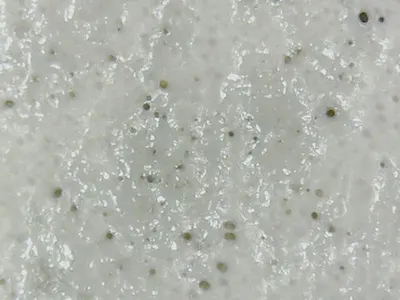
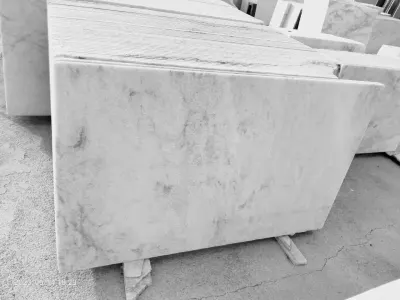
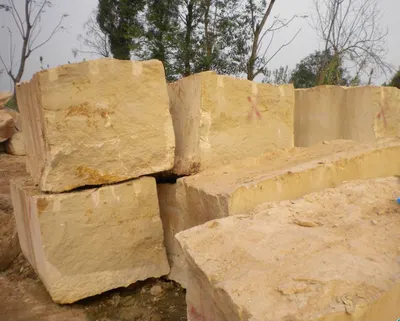
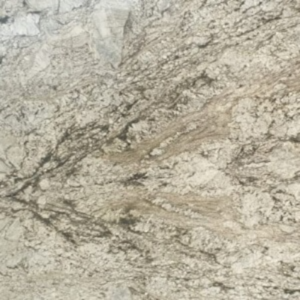
Ajanta Stone Industries lists 5 products drawn from four natural stone families. Modak sandstone is a fine-grained, pink-to-beige variety widely used in Indian construction and exported for paving, cladding, and landscaping; sandstone from India is typically graded by hardness, bedding thickness, and color consistency, with common finishes including natural-cleft, honed, and sandblasted. Marble from India is offered in numerous varieties and is generally traded as slabs (typical sizes around 260-300 cm x 120-180 cm) and tiles, with surface finishes such as polished, honed, brushed, and leathered, and grades typically distinguished by color uniformity, veining, and absence of fissures. Kashmir granite is a light-colored, often white-to-grey or pink-toned Indian granite used for countertops, flooring, and cladding; granite is normally traded in gangsaw slabs (commonly 260-300 cm x 120-180 cm, 2-3 cm thick) and cut-to-size tiles, with specifications including compressive strength (typically 100-250 MPa), water absorption (below 0.5% for commercial grades), and Mohs hardness around 6-7.
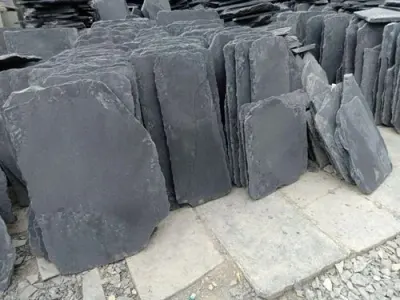
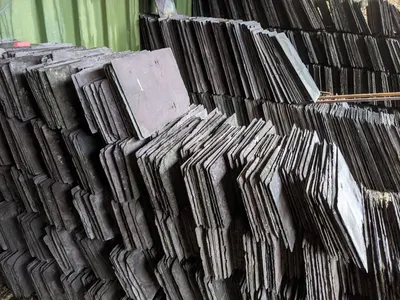
Slate stone is a fine-grained, foliated metamorphic rock sold in irregular flagging, regular tiles, and roofing slates; Indian slate from states such as Rajasthan and Andhra Pradesh is commonly graded by thickness tolerance (often 8-15 mm for flooring), color (deoli green, copper, multicolor, black), and surface (natural cleft or calibrated/honed). Kota blue limestone circle refers to the circular cut pieces of Kota blue limestone, a hard, dense, blue-grey limestone from the Kota region of Rajasthan, widely used for paving circles, stepping stones, and landscape features; Kota limestone is typically specified by density (around 2.3-2.5 g/cc), water absorption under 2%, and thickness grades for flooring versus heavy-traffic applications. Across the catalogue, the unifying trade context is Indian natural stone under HS chapters 2515, 2516, and 6802, with material families that buyers typically evaluate on geological parameters, dimensional tolerances, and finish rather than on chemical composition alone.
Trade and Export Information - Ajanta Stone Industries
Indian natural stone exports are a significant component of the country's building materials trade, with the United States, the United Kingdom, the European Union (notably Germany, Belgium, Italy, and the Netherlands), the Gulf Cooperation Council states (UAE, Saudi Arabia, Qatar), and Southeast Asian markets (Singapore, Malaysia) among the typical destinations for sandstone, granite, marble, slate, and limestone. Sandstone and slate commonly ship under HS code 2516.12 (granite, merely cut into blocks or slabs of a rectangular shape) and 2514 (slate, whether or not roughly trimmed or merely cut), with worked tiles and finished articles falling under HS 6802.10, 6802.20, and 6802.90 depending on the stone type and degree of processing. For marble, the relevant subheadings include 2515.11 (crude or roughly trimmed marble and travertine) and 2515.12 (marble and travertine merely cut into blocks or slabs), with worked forms under 6802.21 and 6802.91. Export shipments from India are typically packed in wooden crates or bundles, loaded into 20 ft and 40 ft dry containers, with average loadings varying by product density - for example, granite slabs roughly 18-25 MT per 20 ft container and limestone/sandstone tiles around 25-28 MT per 20 ft container depending on thickness.
Common documentation and standards required for Indian stone exports include a commercial invoice, packing list, bill of lading, certificate of origin, and for buyers in regulated markets, a CE marking under the Construction Products Regulation for processed stone used in the EU, and conformity to ASTM C615 (granite), C503 (marble), and C629 (slate) for the US market. Indian stone processors are commonly asked to provide test reports on water absorption, density, compressive strength, flexural strength, and abrasion resistance, and many buyers request samples in advance of container orders. Incoterms typically used in this trade are FOB Indian port (Mundra, Jaipur dry port via ICD, Chennai, or Cochin depending on quarry region), CIF, and CFR, with payment by irrevocable letter of credit or advance against documents being standard. Origin-country context matters: Rajasthan is the dominant cluster for sandstone, slate, and Kota limestone, while South India (Tamil Nadu, Karnataka, Andhra Pradesh) dominates granite processing, and buyers often align their supplier selection with the quarry region relevant to the specific stone type.
Sourcing from Ajanta Stone Industries - Buyer Guidance
Buyers sourcing from Ajanta Stone Industries should request product-specific documentation before placing a container order, starting with samples of the exact lot under consideration, since natural stone varies in color, veining, and texture from block to block. For Modak sandstone and slate, request calibrated thickness tolerance (commonly within +/-1 mm for tiles), surface finish specification, and water absorption and density test reports; for marble and Kashmir granite, request slab dimensions, polished finish grade, and physical property test reports covering water absorption (typically below 0.5% for granite, below 1% for dense marble), compressive strength, and flexural strength. For Kota blue limestone circle, request the diameter range, edge finish (hand-cut, machine-cut, or honed), thickness, and a sample of the actual color and texture, as Kota blue varies from light blue-grey to deeper blue tones across quarries. Confirm whether the supplier holds or can arrange relevant third-party test reports and, where applicable, CE marking or ASTM compliance documentation for the destination market, and clarify whether the product is sold as natural, honed, polished, calibrated, or finished. Before ordering, verify the supplier's response time on technical queries, the minimum order quantity (typical for Indian stone exporters is one 20 ft container per product/finish combination, though samples and small LCL shipments are often negotiable), and the production or readiness lead time, which for processed stone is commonly 15-30 days from order confirmation depending on stock versus made-to-order. Request photographs or videos of the current lot, and where possible, an inspection of the finished goods prior to container stuffing, either through a third-party inspection agency or via the buyer's own representative. Clarify packaging norms (wooden crates, ISPM-15 compliant fumigation, plastic wrapping, foam interlayer), loading terms, and the Incoterms basis, and confirm the port of dispatch relevant to the stone type. These verification steps are the standard buyer practice in Indian natural stone trade and are what allow a buyer to distinguish between suppliers with consistent stock and finishing capability and those without.
Frequently Asked Questions About Ajanta Stone Industries
What types of natural stone does Ajanta Stone Industries supply?
Ajanta Stone Industries lists 5 products across four categories: Modak sandstone, marble, Kashmir granite, slate stone, and Kota blue limestone circle, covering the principal Indian natural stone families used in construction, flooring, cladding, and landscaping.
Which HS codes are relevant to the products Ajanta Stone Industries supplies?
The catalogue falls under HS chapter 2515 for marble, 2516 for granite and sandstone, 2514 for slate, and 6802 for worked monumental and building stone articles, with the specific subheading depending on whether the material is rough, cut into blocks/slabs, or further worked into tiles and finished items.
What specifications should a buyer request for the sandstone and slate items?
Request calibrated thickness tolerance (commonly within +/-1 mm for tiles), surface finish (natural cleft, honed, calibrated), water absorption, density, and color consistency samples, as these parameters govern installation performance and visual uniformity.
What physical property test reports are typically required for the marble and granite items?
Buyers typically request water absorption (under 0.5% for commercial granite, under 1% for dense marble), compressive strength, flexural strength, Mohs hardness, and abrasion resistance reports, along with slab dimensions, finish grade, and a current lot sample.
What is the typical minimum order quantity and lead time when sourcing these stones from India?
The standard MOQ for Indian stone exporters is one 20 ft container per product and finish combination, though LCL sample shipments are often available; lead time is commonly 15-30 days from order confirmation, longer for made-to-order sizes or finishes.
Which packaging and shipping norms apply to Indian natural stone exports?
Processed stone is typically packed in fumigated, ISPM-15 compliant wooden crates or bundles with foam interlayer and plastic wrapping, loaded into 20 ft or 40 ft dry containers, and shipped under FOB, CIF, or CFR Incoterms from Indian ports such as Mundra, Chennai, or Cochin.
Which certifications or compliance documents should a buyer request for these stones?
Depending on destination market, buyers typically request CE marking under the EU Construction Products Regulation, ASTM C615 for granite, ASTM C503 for marble, ASTM C629 for slate, and third-party test reports covering water absorption, density, and mechanical strength.
Which markets typically import the stone categories Ajanta Stone Industries lists?
Indian natural stone in these categories is typically exported to the United States, the United Kingdom, the European Union (Germany, Belgium, Italy, Netherlands), the Gulf Cooperation Council states (UAE, Saudi Arabia, Qatar), and Southeast Asian markets such as Singapore and Malaysia.




 , India






.jpg.png)