EcoMatters Technologies — Supplier
About EcoMatters Technologies - Agriculture Supplier in Australia
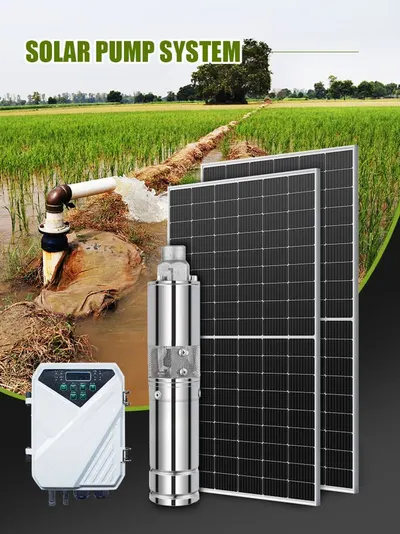
EcoMatters Technologies is based in Australia and currently lists five active solar panel products in its catalogue. The offerings include two mono‑crystalline models (310 W‑335 W and 250 W‑280 W) and three poly‑crystalline models (300 W‑330 W, 250 W‑280 W and 245 W‑265 W), each identified by its nominal power range. All items are presented under the agriculture category, reflecting the use of photovoltaic systems in farm‑scale power generation and irrigation support. The product titles follow the standard industry naming convention of wattage range and crystal type, which aligns with buyer expectations for quick technical comparison.
Product Range and Specialties of EcoMatters Technologies
The mono‑crystalline panels listed by EcoMatters Technologies typically deliver higher conversion efficiency, often between 18 % and 20 %, due to the uniform silicon lattice. Poly‑crystalline panels generally exhibit efficiencies of 15 % to 17 % and are chosen for lower cost per watt. In the global market, solar modules of 250 W to 350 W are common for residential and small‑commercial installations, with standard frame dimensions around 1 600 mm × 1 000 mm and a weight of 18‑20 kg per panel. Buyers usually verify compliance with IEC 61215 (design qualification) and IEC 61730 (safety) standards, as well as UL 1703 for North American markets. Typical certifications also include IEC 62446 for system performance testing.
Trade and Export Information - EcoMatters Technologies
Solar photovoltaic modules fall under HS chapter 85, specifically code 8541.40 for "photosensitive semiconductor devices, whether or not assembled in panels or modules". Australian exporters of such modules often target markets in Southeast Asia, the Middle East, and Europe, where renewable‑energy incentives drive demand. Standard export packaging involves anti‑static wooden crates or bulk pallets wrapped in moisture‑resistant film, allowing safe transport in 20‑ft or 40‑ft containers. Common Incoterms used are FOB Australian ports such as Melbourne or FOB Brisbane, with buyers arranging sea freight to destination ports. Importing countries frequently require test reports confirming IEC 61215 compliance, a warranty statement of 10‑12 years product performance, and a certificate of origin for preferential duty rates.
Sourcing from EcoMatters Technologies - Buyer Guidance
When sourcing solar panels from EcoMatters Technologies, buyers should request the latest IEC 61215 and IEC 61730 test certificates for each panel model. Verify the nominal power output, voltage at maximum power (Vmp) and open‑circuit voltage (Voc) against the supplier’s data sheet, and confirm the cell temperature coefficient. It is prudent to ask for a sample panel or a small‑batch trial to assess mechanical robustness, frame dimensions, and junction‑box specifications before committing to larger volumes. Ensure that the supplier can provide a warranty document, a performance degradation guarantee (typically ≤ 0.5 % per year), and a full set of compliance documents for the target market.
Frequently Asked Questions About EcoMatters Technologies
What types of solar panels does EcoMatters Technologies list?
The catalogue includes two mono‑crystalline models (310‑335 W and 250‑280 W) and three poly‑crystalline models (300‑330 W, 250‑280 W and 245‑265 W).
Are IEC test certificates available for these panels?
Buyers should request IEC 61215 and IEC 61730 certificates from the supplier; these are the standard design and safety certifications for photovoltaic modules.
What is the typical packaging for the panels during shipment?
Modules are usually packed in anti‑static wooden crates or on bulk pallets wrapped in moisture‑resistant film, suitable for 20‑ft or 40‑ft containers.
Which HS code applies to the listed solar panels?
Solar photovoltaic modules are classified under HS code 8541.40, which covers photosensitive semiconductor devices assembled in panels.
What documentation should I obtain before placing an order?
Request the product data sheet, IEC test certificates, warranty terms, and a certificate of origin to verify compliance with the buyer’s import regulations.
What are common lead times for these panels?
Lead times for new orders typically range from 4 to 8 weeks, depending on production scheduling and shipping arrangements.
Which markets commonly import Australian solar panels?
Key import regions include Southeast Asia, the Middle East and Europe, where renewable‑energy projects drive demand for photovoltaic modules.
What minimum order quantity is expected?
Suppliers often set a minimum order of one full container (approximately 300‑350 panels) but may accommodate smaller trial orders upon request.




 , Australia