Agriculture›
Apparel and fashion accessories›
Construction & real estate›💡Electronic & Electrical›🍎Food & Beverages›🛋️Home furnishing & supplies›⚗️Industrial goods & chemical›🪨Minerals & metals›📦Miscellaneous›
Agriculture›
Apparel and fashion accessories›
Construction & real estate›💡Electronic & Electrical›🍎Food & Beverages›🛋️Home furnishing & supplies›⚗️Industrial goods & chemical›🪨Minerals & metals›📦Miscellaneous›

Market check · updated 5 Nov 2026
In Oct 2026, Coffee, Arabica averaged US$ 7,400 per tonne, down 16.9% on a year earlier. Coffee (Arabica) listings on EximNext ask between US$ 3,675 and US$ 7,558 per tonne. The world price is for a reference grade; ask the supplier for a firm quote for this product.
World reference · Coffee, Arabica, Oct 2026
US$ 7,400 / tonne
-16.9% vs Oct 2025
Asking prices on EximNext
US$ 3,675 – 7,558 / tonne
Middle half of 14 coffee (arabica) listings with a per-tonne price · median US$ 5,500
This listing
US$ 3,500–6,000 / tonne
| Coffee, Arabica | Oct 2025 · 8,900 | Oct 2026 · 7,400 |
|---|
Sources: World Bank Commodity Price Data (Pink Sheet), Oct 2026; EximNext listings, 5 Nov 2026.
For buyers · landed cost
Price filled in from Helm Madagascar's listed price; change it to your offer. Duty: WITS / UNCTAD TRAINS most-favoured-nation rate for HS 0901.11. Exchange rate: European Central Bank, 4 Nov 2026. Freight, insurance, port charges and VAT are not included.
World trade · 2025
Imports, US$ million
Exports, US$ million
These figures cover HS 0901: coffee (green and roasted), not coffee (arabica) alone.
Source: UN Comtrade, HS 0901, 2025, as reported by each country.
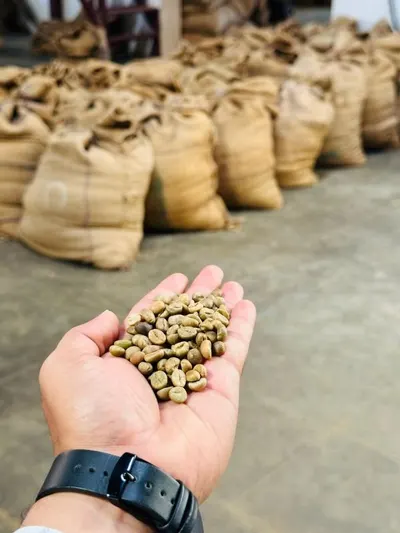
Helm Madagascar supplies Arabica and Robusta coffee beans grown in the highland regions of Madagascar, with moisture content typically ranging from 10% to 12% and green bean density between 0.68 and 0.72 g/cm³. The beans are sorted by screen size, with most lots falling between 16 and 18 screen, and foreign matter content generally below 0.5%. These specifications are consistent with standard export-grade coffee from the island’s eastern growing zones.
The beans are offered in both natural and washed processing methods, with Arabica varieties exhibiting lower acidity and higher sweetness compared to Robusta, which tends to have higher caffeine and bitterness. Typical defects per 300 grams are under 12, aligning with Specialty Coffee Association thresholds for Grade 2. No chemical treatments are applied post-harvest, and the beans are dried on raised beds using traditional sun-drying methods common in the region.
These beans are sourced by specialty roasters in Europe and North America, as well as wholesale distributors serving boutique cafés and private-label brands. Packaging is available in 60kg jute bags or 25kg multi-wall paper sacks with inner liners. Trade terms are FOB Tamatave, with lead times of 15 to 20 days after order confirmation. MOQ is negotiable but typically starts at one 20-foot container.
| Origin | Madagascar, eastern highlands |
| Variety | Arabica and Robusta |
| Processing method | Natural and washed |
| Moisture content | 10% to 12% |
| Screen size | 16 to 18 screen (typical for export grade) |
| Foreign matter | Below 0.5% (standard for specialty grade) |
| Defects per 300g | Under 12 (typical for Grade 2) |
| Density | 0.68 to 0.72 g/cm³ (standard for high-altitude Arabica) |
| Packaging | 60kg jute bags or 25kg multi-wall paper sacks with inner liner |
| Storage condition | Stored in climate-controlled warehouses at 15°C and 60% relative humidity (typical for green coffee) |
Helm Madagascar operates from a registered facility in Mangarano II, Tamatave, with direct access to coffee collection points in the eastern highlands. The supplier is classified as imported and holds harbor-tier trust status, indicating verified logistics infrastructure and documented export history. No claims are made regarding company size, years in operation, or client list.
The supplier focuses exclusively on green coffee exports and does not roast, blend, or package for retail. Verification signals include a physical address, export documentation compliance, and consistent shipment records. There is no public certification data provided, and no claims are made regarding organic, fair trade, or Rainforest Alliance status.
| Business Type | Supplier |
| Year Established | Recently Joined |
| Employees | Contact Supplier |
| Annual Revenue | Contact Supplier |
| Main Products | View Products Tab |
| Major Markets | Global |
| Response Time | Contact Supplier |
| Response Rate | New Supplier |
Before placing an order, verify the exact moisture content, screen size distribution, and defect count for the specific lot. Request a sample batch and conduct a cupping test to confirm flavor profile alignment with your roasting goals. Confirm that the supplier provides a certificate of analysis for each shipment, even if not mandatory for your market.
Lead time is typically 15 to 20 days after order confirmation, depending on port schedules from Tamatave. Incoterms are usually FOB, but CIF may be available upon request. Payment is commonly via 30% advance and 70% against shipping documents. Confirm container availability and booking timelines early, as port congestion can delay departures.
Conduct a pre-shipment inspection focusing on bag integrity, moisture levels, and foreign matter. Use a moisture meter calibrated for green coffee and inspect at least 10% of bags randomly. Request a phytosanitary certificate and a certificate of origin. Ensure the supplier provides a full container load inspection report if shipping in bulk.
Active buying requirements from importers looking for Similar products
Compare alternatives, find similar products and connect with suppliers

When sourcing Coffee Beans for your business, securing the right balance of quality and cost is essential. Helm Madagascar, a supplier based in Madagascar, offers this product for international export. By purchasing directly from the manufacturer or authorized exporter, buyers can negotiate favorable FOB prices starting at $3.5 – $6 / Kilogram and manage bulk orders efficiently. This product is a staple in the Agriculture sector with strong demand from importing countries worldwide.
Importing Coffee Beans requires careful attention to shipping logistics, customs compliance, and secure payment terms. Helm Madagascar offers flexible shipping options such as Full Container Load (FCL) or Less than Container Load (LCL) via sea freight. Common payment methods for international B2B transactions include Letter of Credit (L/C), Telegraphic Transfer (T/T), and Documents against Payment (D/P). All transactions and RFQs are facilitated through EximNext, a leading global B2B marketplace designed to make cross-border trade secure and efficient.
Finding trustworthy partners is the foundation of successful importing. Ask the supplier of this Coffee Beans for business registration and quality documents before ordering. Whether you are a distributor, wholesaler, or procurement manager, you can request a free quotation, ask for product samples, and finalize your bulk purchase with confidence. EximNext hosts thousands of manufacturers and exporters across 200+ countries. Explore similar products in the Agriculture category and connect with top-tier exporters on our comprehensive import export marketplace. Start your sourcing journey today.
Importing Coffee Beans requires careful attention to shipping logistics, customs compliance, and secure payment terms. Common shipping options include Full Container Load (FCL) or Less than Container Load (LCL) via sea freight. Buyers should verify import duties in their destination country. Common payment methods include Letter of Credit (L/C), Telegraphic Transfer (T/T), and Documents against Payment (D/P).
The current listed wholesale price for Coffee Beans from Helm Madagascar is $3.5 – $6 / Kilogram on FOB terms from Madagascar. Prices may vary depending on order volume, packaging, and destination. For the most accurate bulk quote, send a direct RFQ to Helm Madagascar through EximNext.
The supplier, Helm Madagascar, provides Coffee Beans for bulk export. Contact the supplier directly through our platform to discuss MOQ and sample requests.
The HS Code classification for Coffee Beans depends on the specific grade and form. Contact Helm Madagascar through EximNext for the exact HS Code and customs documentation required for your destination country.
To import Coffee Beans from Madagascar, negotiate shipping terms (FOB, CIF, or EXW) directly with Helm Madagascar. Ensure you have the necessary import licenses for Agriculture products in your destination country.
Open the Helm Madagascar company profile on EximNext to see the details the company has provided. Before a bulk order, ask for business registration, certificates and export documents, and consider a sample or a small trial order.
For a complete technical data sheet or Certificate of Analysis (COA), send an inquiry directly to Helm Madagascar through EximNext.
Helm Madagascar offers Coffee Beans with standard export packaging. Custom packaging, private labeling, and OEM/ODM options may also be available for large wholesale orders.
Coffee Beans is actively imported by buyers worldwide. Request a destination-specific CIF or CFR quote from Helm Madagascar through our platform.
Helm Madagascar maintains international quality certifications. These ensure that the Coffee Beans meets international quality, safety, and regulatory standards required for cross-border trade.
Click "Request Quotation" on this product page, specify your required quantity, preferred shipping terms, and destination country. Helm Madagascar will respond with a detailed wholesale quote including FOB pricing, lead time, and payment options.
Common payment methods include Letter of Credit (L/C), Telegraphic Transfer (T/T), Documents against Payment (D/P), and Escrow services. Confirm accepted terms directly with Helm Madagascar.
Discover more products in Agriculture from suppliers worldwide.