Swan International — Verified Supplier
About Swan International - Stainless Steel Utensils Supplier in India
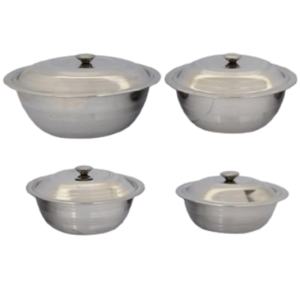
India hosts Swan International, which currently lists five distinct stainless‑steel product lines in its catalogue. The active product count of five includes mixing bowls, kitchen and serving tools, cutlery sets, deep colanders, and a combined range of kitchen utensils and cutlery, all classified under the broader tableware and kitchenware categories of HS Chapter 73. The supplier’s top categories are identified as Stainless Steel Utensils, Cutlery (fork, knife, spoon & chopsticks), and Serving Bowls, reflecting a focus on food‑service and household applications. Each entry is presented without reference to specific certifications or revenue figures, keeping the description strictly factual.
India’s stainless‑steel manufacturing sector supplies a broad selection of food‑grade items to global markets, and Swan International’s catalogue aligns with this export profile. The listed products are typically made from food‑grade stainless steel alloys and are intended for commercial kitchens, catering services, and domestic use. By providing both individual items such as deep colanders and composite ranges like kitchen utensils and cutlery, the supplier covers multiple points in the kitchenware supply chain. The catalogue does not disclose any proprietary processes or client references, adhering to the supplied facts.
Product Range and Specialties of Swan International
Swan International’s catalogue includes stainless‑steel mixing bowls, a variety of kitchen and serving tools, standard cutlery sets, deep colanders, and an integrated line of kitchen utensils and cutlery. In the stainless‑steel kitchenware sector, buyers commonly encounter grades 304 (18‑8) and 316 (marine grade) which meet food‑contact regulations, and finishes ranging from polished to brushed to meet hygiene standards. Typical specifications for mixing bowls involve capacities from 1 L to 5 L, wall thickness of 0.5 mm to 1 mm, and dishwasher‑safe construction. Cutlery sets are usually offered in standard dimensions - forks 180 mm, knives 180 mm, spoons 190 mm - with ergonomic handles and anti‑corrosive surfaces. Deep colanders often feature perforation sizes of 3 mm to 6 mm and overall diameters of 300 mm to 500 mm, facilitating efficient draining.
Trade and Export Information - Swan International
Indian exporters of stainless‑steel kitchenware primarily serve markets in North America, Western Europe, the Middle East, and Southeast Asia, where food‑service establishments demand durable, corrosion‑resistant products. The HS Chapter 73 classification covers these items, and shipments are usually packed in cardboard cartons with internal dividers, placed on 20‑ft or 40‑ft containers for ocean freight. Commonly required certifications for such products include FDA compliance for food contact, LFGB for the European market, and BRC or ISO 22000 for broader safety assurance; buyers should verify these documents before finalizing contracts. Export logistics from Indian ports such as Mumbai and Chennai often employ CIF or FOB Incoterms, with standard lead times of 30‑45 days from order confirmation to shipment.
Sourcing from Swan International - Buyer Guidance
When sourcing stainless‑steel kitchenware from Swan International, buyers should request a material test report confirming the stainless‑steel grade, corrosion resistance, and compliance with relevant food‑contact standards. Samples of mixing bowls or cutlery can be requested to evaluate finish quality, dimensional tolerance, and durability under dishwasher cycles. Verification of certifications such as FDA or LFGB should be obtained as part of the due‑diligence package, and buyers may also ask for a factory audit report if required by their internal procurement policies. Confirming packaging details - carton dimensions, pallets, and moisture barrier liners - helps ensure the goods arrive undamaged, especially for deep‑colander and bowl shipments that are prone to denting.
Frequently Asked Questions About Swan International
What stainless‑steel grades are used in Swan International’s cutlery and kitchen tools?
The catalogue does not specify grades, but stainless‑steel kitchenware from India is typically produced in food‑grade 304 or 316 alloys. Buyers should request a material test report to confirm the exact grade supplied.
Are the mixing bowls suitable for commercial dishwasher use?
Standard stainless‑steel mixing bowls are designed for dishwasher cycles, with wall thicknesses of 0.5 mm to 1 mm that resist warping. Verify the supplier’s sample for any surface coating that might affect dishwasher performance.
Which certifications should a buyer request for these stainless‑steel products?
For food‑contact applications, buyers normally ask for FDA compliance documentation, LFGB certification for the EU, and optionally BRC or ISO 22000 safety certificates. These should be provided before contract signing.
What are the typical packaging formats for the deep colanders?
Deep colanders are usually packed in reinforced cardboard boxes with internal separators, placed on standard Euro pallets (1200 mm × 800 mm). This protects the perforated surfaces during transit.
What HS code family do these items fall under for customs clearance?
Stainless‑steel kitchenware and tableware are generally classified under HS Chapter 73, which covers articles of iron or steel. The exact sub‑heading depends on product type, such as cutlery or bowls.
What is the usual minimum order quantity (MOQ) for the stainless‑steel utensil set?
Indian stainless‑steel manufacturers often set MOQs between 1,000 units and 5,000 units per SKU, depending on the product complexity. Buyers should confirm the specific MOQ with Swan International during quotation.
What lead content limits apply to stainless‑steel kitchenware?
International food‑contact standards typically limit lead to less than 0.1 mg/kg in stainless‑steel products. Request a compliance test report to ensure the supplied items meet this threshold.
Which Incoterms are commonly used for shipping these products from India?
Exporters from India frequently use FOB (Free on Board) at the port of loading or CIF (Cost, Insurance, Freight) to the buyer’s destination. The chosen term should be agreed upon in the sales contract.




 , India