Minggang Commercial Induction Cooker Factory — Supplier
About Minggang Commercial Induction Cooker Factory - Commercial Induction Cooker Supplier in China
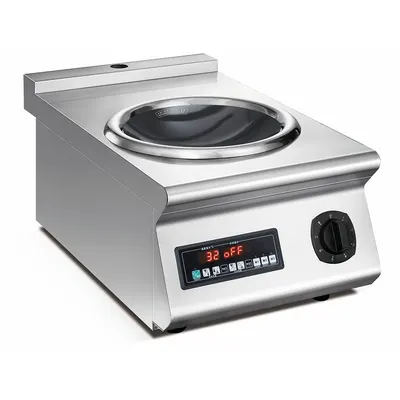
Minggang Commercial Induction Cooker Factory operates in China and currently lists five distinct commercial induction cooker models. The catalogue includes a standard Commercial induction cooker and four variants identified as gTSA, gTSp, tsp, and qra. All five items are classified as electric cooking appliances intended for professional food‑service environments. The supplier’s product count of five reflects a focused range rather than a broad portfolio. Each model is presented under the generic commercial induction cooker category without additional sub‑categories in the supplied data.
The five models are designed for high‑intensity cooking tasks such as stir‑frying, boiling, and rapid heating in restaurants, hotels, and catering facilities. Typical commercial induction units in this segment operate at power levels between 2 kW and 7 kW and are supplied for 220‑240 V three‑phase power supplies. Control interfaces commonly include digital touch panels, programmable timers, and safety features such as over‑temperature protection. While the catalogue does not provide specific technical parameters, buyers can expect the products to fall under the electrical appliance category covered by HS Chapter 85, which includes electric cooking appliances. The supplier’s focus on a single product family suggests specialization in induction technology rather than a diversified kitchen equipment line.
Product Range and Specialties of Minggang Commercial Induction Cooker Factory
The catalogue from Minggang Commercial Induction Cooker Factory consists of five entries: Commercial induction cooker, Commercial induction cooker‑gTSA, Commercial induction cooker‑gTSp, Commercial induction cooker‑tsp, and Commercial induction cooker‑qra. These designations indicate variations that may differ in power rating, control logic, or auxiliary features, a common practice among manufacturers of professional induction equipment.
In the broader market, commercial induction cookers are offered in standard power classes such as 3 kW, 4.5 kW, and 6 kW, with surface temperatures controlled to ±5 °C. Typical specifications include a copper induction coil, stainless‑steel cooking surface, IEC‑60335 safety compliance, and a CE mark for European markets. Buyers also encounter optional features like built‑in booster zones, Wi‑Fi connectivity, and modular pan detection. The product family listed by Minggang aligns with these industry norms, providing a base for customized specifications according to end‑user requirements.
Trade and Export Information - Minggang Commercial Induction Cooker Factory
China is a leading exporter of electric cooking appliances, and commercial induction cookers are routinely shipped to North America, Western Europe, the Middle East, and Southeast Asia. Importers usually classify these items under HS 8516.50, the heading for electric cooking appliances, which subjects shipments to standard customs duties and safety‑related inspections. Commonly required certifications for this category include CE marking for the EU, UL listing for the United States, and ISO 9001 quality‑management system audit for many buyers.
Logistically, induction cookers are packed in reinforced wooden crates or metal pallets to protect the heavy copper coil and electronic controls during sea freight. Standard container utilisation ranges from one to two units per 20‑ft container, depending on unit dimensions, with typical gross weights between 80 kg and 150 kg per unit. Incoterms such as FOB Shanghai or CIF Rotterdam are frequently used, allowing buyers to arrange onward transport while the supplier manages export customs clearance. Export documentation generally includes a commercial invoice, packing list, certificate of origin, and test reports confirming compliance with IEC 60335‑2‑23.
Sourcing from Minggang Commercial Induction Cooker Factory - Buyer Guidance
When sourcing from Minggang Commercial Induction Cooker Factory, buyers should request detailed product data sheets that specify power rating (kW), voltage (V), frequency (Hz), control interface type, and safety certifications such as CE or UL. A third‑party compliance test report, for example an IEC 60335 safety test, helps verify that the unit meets international safety standards before shipment. Samples or pre‑production prototypes are advisable to assess build quality, pan detection accuracy, and surface temperature uniformity.
Before confirming an order, verify the supplier’s ability to provide the required export documents, including a certificate of origin and any applicable conformity certificates. Clarify the minimum order quantity (MOQ), which for specialized induction units often starts at a single unit for prototype testing and scales up to container loads for mass procurement. Confirm lead times, which typically range from 30 to 60 days for production after final design approval, and agree on packaging details such as crate dimensions, cushioning material, and labeling requirements.
Frequently Asked Questions About Minggang Commercial Induction Cooker Factory
What power ratings are available for the commercial induction cookers listed by Minggang?
The catalogue does not list exact power ratings, but commercial induction units from China commonly come in 3 kW, 4.5 kW and 6 kW versions. Buyers should request the specific kW rating for each model (gTSA, gTSp, tsp, qra) in the product data sheet.
Which safety certifications should be requested for these induction cookers?
Typical certifications include CE marking for EU markets, UL listing for the United States, and compliance with IEC 60335‑2‑23 safety standards. Ask the supplier to provide test reports or certificates confirming these standards.
What is the usual packaging method for commercial induction cookers shipped from China?
They are normally packed in reinforced wooden crates or steel‑framed pallets with internal foam cushioning to protect the copper coil and electronic controls. The crate dimensions and gross weight are specified on the packing list for freight planning.
Which HS code is most commonly applied to commercial induction cookers?
Importers generally classify electric cooking appliances under HS 8516.50, the heading for electric cooking appliances. This code is used for customs declarations and duty assessments.
What Incoterms are typically used for exporting these cookers?
Suppliers from China often quote FOB Shanghai or CIF Rotterdam, allowing the buyer to manage import customs and inland transport while the supplier handles export clearance.
What documentation is required before shipping the induction cookers?
Standard export documents include a commercial invoice, packing list, certificate of origin, and any conformity certificates (CE, UL, IEC test reports). These documents facilitate customs clearance in the destination country.
Is a sample or prototype available before a full order?
Most Chinese manufacturers will provide a single prototype or sample unit for performance verification. Request lead time and any associated cost for the sample in advance.
What are typical lead times for production after design approval?
Lead times for commercial induction cookers usually range from 30 to 60 days, depending on the complexity of the control system and the volume of the order. Confirm the exact schedule with the supplier once the final specifications are agreed.




 , China